Do you like hitting Personal Records (PR)??!! What about training trends and seeing your Garmin trail watch claim “Improving” or best yet….the VO2 Max setting tells you that you’re now “SUPERIOR”??!! Pretty awesome, right? Feeling on your game? Well, what about when more often than not it tells you that you’re training status is …. wait for it…. UNPRODUCTIVE. Or 1 mile into the trail you normally blaze the watch beeps and you look down and see the dreaded ( – 1 ) or ( – 2 )?? Does that just absolutely enrage you or am I unique on that one?
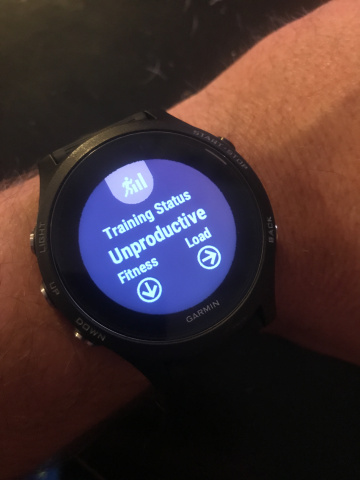
The question to ask is what the hell is the watch measuring anyway? How does the little genie inside it know you’re being productive, unproductive or that you’ve somehow morphed into a tree sloth? The answer tends to be two specific measurements that we will ultimately discuss: VO2 Max and Lactate Threshold. For this article’s purposes we shall focus on VO2 Max as it is widely discussed in multiple forums and why I believe it to be useful but why I’ve also dubbed it Satan’s Statistic.

In short VO2 Max is a measurement of the limits of the cardiorespiratory systems’ ability to transport oxygen from the air to the tissues at a given level of physical conditioning. Essentially, how aerobically efficient are you during effort driven endurance events extracting energy from breathing oxygen. And can you through training increase this value giving yourself an indication of enhancing performance? The more you can oxygenate your muscles efficiently, the more energy you can exchange, and thus the more power and endurance you can expect to achieve. So what would limit this? Ethereal “conditioning” be it muscle fiber recruitment or density, heart muscle reactivity, blood vessel permeability, energy storage efficiency, energy utilization, mitochondrial activity are all real issues that independently determine performance and are often interdependent. Does VO2 Max simplify our understanding of all these complicated micro-interactions or is it just fancy bullshit that only matters if you’re Lance Armstrong or Killian Jornet?

Alright Mr. Fancy jargon guy now I know the basics. Cut to the chase. How do we calculate this? There are multiple methods. One appears to be where you become a better athlete than you are and get sponsored by Gatorade and go into a lab where they intubate you, wire you up 800 ways, get you on a bike or treadmill, implant nanotech into your bloodstream and extract your soul with this contraption:
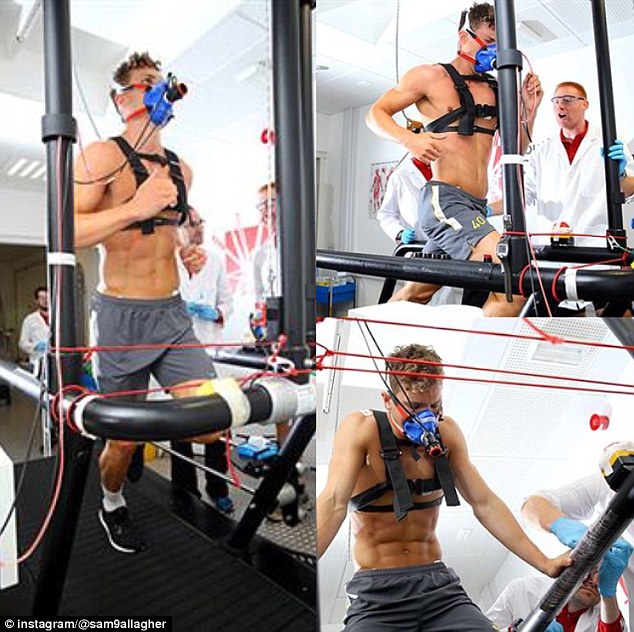
That might actually be how the black market harvests your kidneys. I can’t promise you the results if you decide to get sponsored by Nike or whatever body shaming corporate equivalent you’re into these days.
Other more reasonable options for measuring VO2 Max seem to be:
1. Non-Fitness Test Method: VO2Max = 15 x HRmax/HRrest. Check your resting HR in the morning per minute and Max while on the treadmill or trail. Thus say your max is 175 bpm and your resting rate is 55 bpm then ….
VO2 max = 15 x 175/55 : 47 ml/kg/min
2. Light Jog Test – Check your resting HR and then lightly jog 1 mile with a HR chest strap under very light speed to check your new HR and time.
Women: 100.5 – (0.1636 x weight in kg) – (1.438 x jog time) – (0.1928 x heart rate)
Men: 108.844 – (0.1636 x weight in kg) – (1.438 x jog time) – (0.1928 x heart rate)
3. Generating a Running VO2 Max Estimate on a GPS enabled device:
- Running Activity must be 10 minutes or longer in length
- Activity must be recorded outdoors with a GPS signal
- Heart rate data from either a built in optical heart rate sensor or from a chest strap
- Heart rate must be elevated to 70% of your maximum heart rate
Conclusions and Thoughts:
OK…..I have the magical number!!!! Now what the hell does it mean????
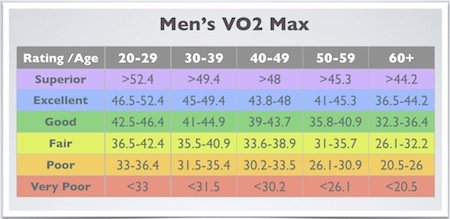
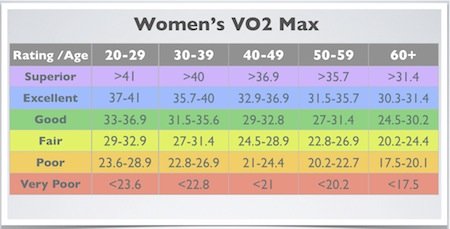
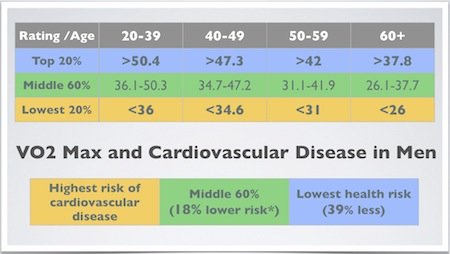
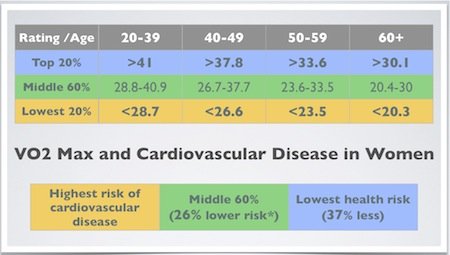
One great option is to use it as an age based comparison so you can feel really horrible about yourself!! But as I’ve personally learned “comparison is the thief of joy” so be careful on that one. As a singular comparison, however, to how YOU performed compared to YOURSELF in the past if can be very valuable. This can help you determine where you are headed overall in your training. There are also many charts and health based statistics that I’ve shown here that at least can give you an indication that if your first VO2 Max assessment is garbage …. perhaps it’s time to get after it and use this moment as a wake up call for your health.
Shall I use it then simply as a basic metric of personal performance?
Like a lot of athletes I do like data. But I also like it hand fed to me at times like bamboo to a baby Panda. And mostly I want the data to be consistent from one workout to the next so I can compare my perceived performance and improvement. Otherwise, it’s all just a complete crap shoot. But with VO2 Max assessments you get ONE shot at it with your Garmin or Training Watch of choice. Unlike pacing, HR zone training, elevation metrics that ping you indicating changes in performance across a given workout….the VO2 assessment is usually done one time and one time only. Blow it and you might as well not bother.
My experience has been that if you are interested in this data point you would want to wear a chest HR strap. Turn on your trail watch and map out a 15 minute window of run. You want to keep your pace even, your HR low for as long as you can, breathe through your nose to stay aerobic and not clip too quick into rapid breathing anaerobic territory but gain ground smoothly and efficiently without feeling completely toast at the end of that window. In that sweet spot you will receive a positive affirmation of an escalating or pleasant adjective riddled comment such as ‘Excellent’ or ‘Superior’ as well as a numbered value to use for your next performance run.
Ultimately, I do think it is a valuable statistic, follow it and track it while you’re gearing up for a race …. but if you put all your money on it then it’s Satan’s statistic that you will frustratingly chase like weight on a scale. Don’t get too wrapped up in it, use it for what it is – An indicator of performance. Then do what you were going to do anyway. Hit the Trail and enjoy the run!!

**The author is an adventure Obstacle Racer and terrain Trail Runner. Follow my journey here by clicking on the subscribe button and on Instagram for more fun and excitement @drshepherdvfps
 Shep: The SpiderMonkey Chronicles